How to Do Really Well in Clinical Medicine Exams
A quick story of how I got in the top 15% in my 4th year exams at Cambridge

At the start of 4th year (start of clinical school at Cambridge) I was very lost on where to start and how to even approach the year. After trying everything, I have tried to put together what worked and what didnt, so hopefully you don’t waste time figuring it out like me…
At the beginning of clinical school, we were given a piece of advice that sounds almost impossible to disagree with: go into the wards every day, see patients and research the conditions you encounter. We were told by our dean that doing this consistently was the route to a distinction (roughly, finishing within the top 15% of the year).
There is a lot that is right about this. It will probably make you a better doctor.
But if you do only this, I think you are more likely to finish in the bottom 15% than the top.
The problem is not the wards. Learning medicine and performing well in medical school examinations are related, but they are not the same task. Patients do not follow textbooks. Exams, by necessity, mostly do.
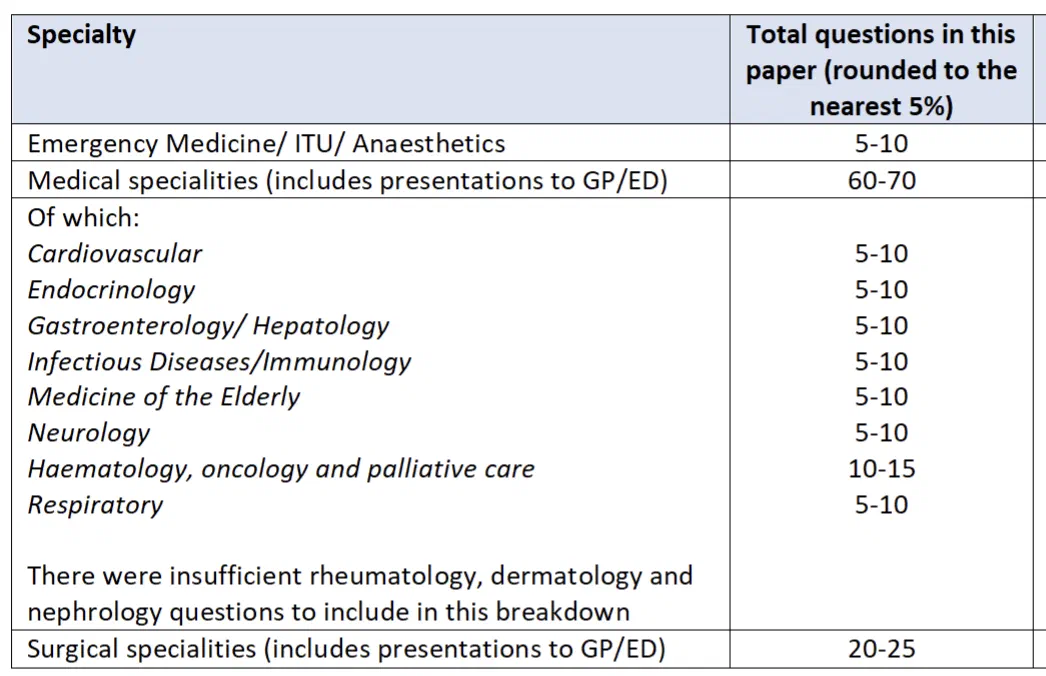
In my fourth year, the assessment consisted of a three-hour single best answer paper covering almost every specialty we had studied, followed by five examination and five history-taking OSCE stations. Cambridge’s current course information still describes Year 4 assessment as a written test spanning the major clinical specialties and an OSCE assessing practical, examination and communication skills.
Once I understood the format, the basic principle became obvious: revise according to the examination you are actually going to sit.
PS. All the resources that I used/mention are uploaded onto the resources page of the website. I hope these are of some use to you all.
PSS. Perhaps the most important factor that contributed to my success is mentioned at the end (and no, its not more revision).
The system that nearly burnt me out at the start.
The transition from preclinical to clinical medicine was surprisingly disorientating. Preclinical learning was mostly structured around lectures. In clinical school, much more of the responsibility suddenly belonged to you.
I began by trying to learn everything properly. I used the Cambridge conditions list, made extensive notes, created my own Anki cards, completed PassMed questions, went into placement and tried to maintain the rest of my life — including competing in badminton at county and national level.
The plan looked excellent on Notion. This was part of the problem.
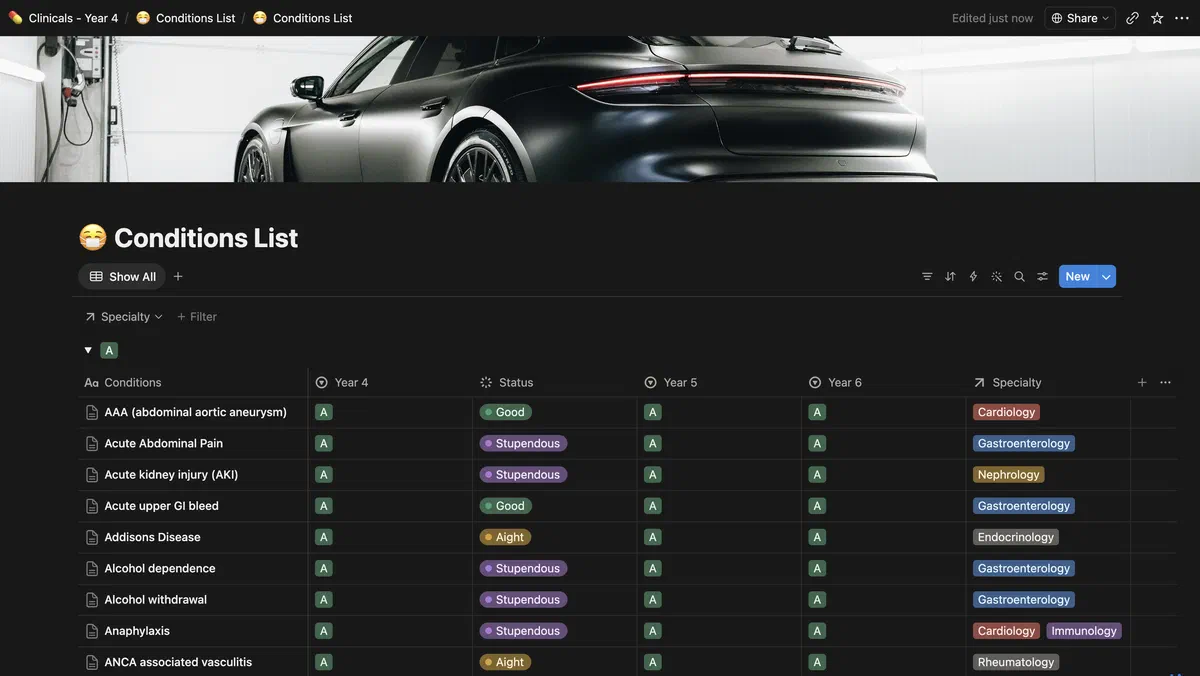
Within weeks, I had created a system capable of consuming every available hour while still leaving me convinced I was behind. Making comprehensive cards before testing myself meant spending enormous amounts of time deciding what might matter. I was memorising clinical medicine as though I would later have to reproduce it in a preclinical essay.
But the 4th year exam consisted of a 1 3hr single best answer (SBA) paper and 2 sets of OSCEs. For any of these exams, I did not need to recite the textbook (unlike the essays in pre-clinical medicine). I needed to recognise presentation patterns, distinguish plausible options and retrieve the fact that separated the right answer from four nearly-right ones for the SBA.
Around January, I shifted towards learning through questions. At first, I planned simply to repeat my incorrect PassMed questions. Sometimes I got the same question wrong again; other times I remembered the answer because I recognised the wording.
Neither meant I had fixed the gap.
What actually works and how to smash the SBA.
The method improved when I stopped treating a wrong question as something to repeat and started treating it as evidence.
Every incorrect answer had a cause. Perhaps I did not know the investigation of choice, confused two similar presentations or had forgotten an important contraindication. That missing concept — not the whole condition and not the original question — earned an Anki card.
The loop became:
answer questions → identify the precise knowledge gap → make a focused card → retrieve it later without the original question
My Notion notes remained useful as a reference. I organised conditions into pathophysiology, investigations and differentials, complications, and management. But the questions decided which parts needed to enter active memory.
Initially, I worked through one specialty at a time. Later, I mixed everything together so that practice resembled the real exam. By April or May, I had moved from roughly 50 questions per day to a strict target of 200.
That number is not sacred. The useful principle is that question volume only helps when mistakes generate learning. Two hundred questions completed on autopilot can become an elaborate way of clicking buttons.
This is more than enough to comfortably get >70% on the SBA. But if you want to be aiming for >80%, I recommend the following. At cambridge, the questions require you to think a little and carry out 2/3 steps before arriving at the answer, whereas PassMed (most of the time) just relies on rote memorisation. Because of this, I highly recommend doing all the moodle questions available and going through the reasoning behind answers to each question thoroughly, along with prioritising your revision around the conditions tested in these questions.
What to do on the wards?
This is not an argument for abandoning placement. Cambridge assesses attendance and overall performance on placements as well as formal examinations. More importantly, the wards teach things a question bank cannot: how illness varies, how patients describe symptoms, how uncertainty feels and how clinical teams make decisions.
But “go to the wards” is not yet a learning plan.
I found that one or two focused hours on most days could be enough if I arrived with a goal. A typical target was two examinations and one history. That is more useful than spending an entire day on a ward and hoping education happens to you.
Patients are not OSCE props. Practising clinically still requires consent, appropriate supervision and respect for confidentiality. GMC guidance is clear that patients should be comfortable with a student’s involvement and that students participate within suitable supervision. The aim is deliberate learning, not turning placement into a scavenger hunt.
How to smash the OSCEs.
In all honesty, I left concentrated OSCE revision quite late. I had practised examinations intermittently on the wards, and a mock in November forced me to learn the core cardiovascular, respiratory and gastrointestinal examinations properly. Surprisingly, much of that stayed in my memory.
Nearer the exam, I practised the sequences repeatedly with friends and, when no friend was available, on a pillow. The aim was to make the basic order automatic. In an OSCE, you do not want to spend your limited attention remembering what comes after inspection; you want to notice findings, communicate clearly and structure the viva.
I also benefited from a three-day gap between the SBA and my OSCEs. Some students had their OSCE the following morning, so I would not build an entire strategy around receiving the same kindness from the timetable.
The most important thing…
In my three pre-clinical years, I thought revising all day, every day during Easter term was the best way to get as much information as possible into my brain before the exam. Very wrong. You need breaks. Otherwise, you cannot be efficient, your memory gets worse, and you simply cannot think straight, at least that was the case for me.
For me, the gym is so important. I made my 1 hour 20 minute gym session every day during Easter term of fourth year a non-negotiable. It ensured I had a way to de-stress after a long day of work, and I would go at night after I had finished everything for the day. This one thing had compounding effects on my efficiency and recall.
So, my advice would be to dedicate at least an hour, even during exam season, to doing an activity you love, preferably one that involves moving your body, as this is directly correlated with improvements in memory and the release of endorphins.
Final thoughts.
Exam success is easy to overinterpret. Doing very well in SBAs may show broad knowledge, strong recall and good pattern recognition. It does not automatically mean you will be excellent with real patients.
Real patients arrive with several conditions at once. They give incomplete histories. Their investigations conflict. Occasionally, they have not read the relevant PassMed explanation.
The wards and the exam solve different problems. Question banks give systematic coverage. Anki repairs retrieval failures. OSCE practice gives structure. Patients teach variation, judgement and humanity.
Clinical school gives you much more independence than preclinical medicine. The mistake is interpreting that independence as an absence of structure. It means the responsibility for building the structure has quietly moved to you.
And finally, I want to wish everyone the very best of luck, and please do get in touch if you have any questions at all!