The Blueprint to Getting Into Cambridge Medicine
How I approached my Cambridge Medicine application, what worked, and what I would do differently if I had to do it all over again.


So, you’re doing quite well at school and think you might have what it takes to have a shot at one of the best universities in the world. Great. You’re in the right place.
I’m going to explain how I approached my own application, what I think worked, and what I would do differently if I had to do it all over again. A lot of the principles here can probably be generalised to other Cambridge subjects, but I’m deliberately going to speak mainly about Medicine. That is what I applied for, and I don’t think it would be particularly useful for me to pretend I know exactly how to get into Cambridge for Engineering, History or Maths when I have never done it.
The central idea is quite simple: if Cambridge is genuinely your goal, you should treat the next 18 months or so as an optimisation problem. Work out what actually increases your probability of getting an offer, remove the things that do not, and keep making yourself a stronger applicant every week.
I like to imagine it as a progress bar. At the beginning of Year 12, perhaps you are at 10%. By the time you sit your interview in Year 13, you want that bar as close to 100% as you can possibly get it.
Everything in this article is about moving that bar.
Start by removing things that do not move the progress bar
Let’s go all the way back to the beginning of Year 12.
I originally picked Biology, Chemistry, Maths and Further Maths. After approximately one day of Further Maths, I dropped it.
It wasn’t because I thought Further Maths was too hard, or because there was anything wrong with the subject. I realised that it was not essential for the outcome I cared about. I wanted to get into Cambridge for Medicine, and every hour I spent doing something unnecessary was an hour I could have spent becoming better at something that actually mattered for that application.
There is a deeper principle here.
Getting an offer from Cambridge Medicine is already difficult enough. You do not need to voluntarily make the process harder by collecting commitments simply because they sound impressive. If you are serious about this goal, particularly if you are reading this near the beginning of Year 12, start thinking about opportunity cost.
Ask yourself: does this actually increase my chance of becoming a stronger Cambridge Medicine applicant?
Sometimes the answer will be yes. Sometimes it will be no.
That does not mean you should turn into a machine that refuses to see friends for two years because socialising has insufficient admissions ROI. It means that when you are deciding how to allocate serious chunks of your working time, you should know what your priorities are.
Cambridge is not looking for the person with the longest list of activities. You need to become exceptionally good at the things that matter.
Year 12: get ahead of your school
My main academic goal in Year 12 was to get substantially ahead of where my school was teaching.
For Biology and Chemistry, I tried to complete around two “lessons” per subject per day. By a lesson, I do not mean an entire chapter of a textbook. I mean the smallest sensible subsection of a topic that I could learn properly. For Maths, I generally did closer to one.
The exact number is not sacred. Please do not finish this article believing that Cambridge has a secret admissions criterion requiring precisely two pages of organic chemistry at 7:13pm every evening.
The principle matters more: you should aim to learn the course faster than school teaches it.
There are several advantages to doing this.
First, your actual lessons at school stop being the first time you encounter the material. They become revision. The teacher explains something you have already studied, which gives you another opportunity to consolidate it, notice gaps and ask better questions.
Second, topic tests become much less stressful because you are not constantly learning everything just before you are tested on it.
Most importantly, you arrive at your Year 12 mocks extremely well prepared.
And those mocks matter.
One of your biggest goals during Year 12 should be putting yourself in the strongest possible position for your predicted grades. Cambridge currently assesses Medicine applicants using their academic record alongside the UCAT and interviews, so your academics are not something you want to be scrambling to fix in the autumn of Year 13.
Ideally, by the time everyone suddenly becomes very concerned about their UCAS application, you have already spent a year building the academic foundation for yours.
What you should do for your super-curriculars
At the same time, you should start developing academic interests beyond the A-level specification.
This is where I would make an important distinction. People often talk about “extracurriculars”, but what matters much more for an academic application is what Cambridge calls supercurriculars: things you have done to explore your subject beyond what your school requires.
If your school offers you the opportunity to do a research project, take it. If there is a topic in Biology that genuinely interests you, read further into it. Read papers. Explore a question independently. Produce a poster or presentation. Write an article about something you have investigated and present it to people at school.
Competitions and academic programmes can be useful too, where they genuinely develop relevant thinking.
The important part is not collecting certificates. It is developing intellectual depth.
Imagine two applicants.
One says, “I attended a biology lecture.”
The other became interested in a particular question after the lecture, read around it, found a paper they disagreed with or did not understand, investigated the underlying biology and can now have a ten-minute conversation about what they learnt.
Those are completely different things.
The second person has actually become more interesting to teach.
That matters later because your supercurricular work does several jobs simultaneously. It gives you substance for your UCAS application, gives you things you can discuss academically, expands your knowledge and, perhaps most importantly, trains you to follow your curiosity rather than waiting for a teacher to tell you what appears on the next exam.
That is much closer to the kind of learning Cambridge is trying to select for.
In my own case, the written part of the application drew heavily on the academic things I had actually done: the school Genome Project, designing nanoscale DNA models with caDNAno, science seminars, a collaborative presentation on COVID-19 vaccines, and wider reading around topics such as receptor-mediated endocytosis and medical ethics.
If you want to see exactly how I wrote about those things at the time, you can view my personal statement in the resources section here.
Towards the summer switch some of your attention to the admissions test
Towards the end of Year 12, I started preparing for my medical admissions tests.
My application cycle was different from the current one. I had to prepare for both the UCAT and the BMAT. I spent roughly six weeks preparing for the UCAT and around eight weeks on the BMAT, doing smaller amounts consistently because by then I was back at school.
The BMAT is no longer part of the Cambridge Medicine application. Cambridge Medicine now requires the UCAT.
So if I were applying now, I would redirect the time I spent preparing for the BMAT elsewhere.
Again, this is the progress-bar idea.
For those weeks, the marginal value of an hour of UCAT practice might be much higher than the marginal value of doing another unrelated activity. So I would deliberately move more time towards UCAT preparation.
But I would not make the mistake of thinking that the UCAT is the application. Cambridge assesses Medicine applicants through a combination of academic record, UCAT and interview.
You are building the whole applicant.
Your UCAS application should show what you actually did with your interest
The personal statement has changed since I applied. Current applicants now answer three UCAS questions rather than writing one continuous essay, although the overall character limit remains 4,000.
If I were writing mine again now, I would spend far less time trying to sound passionate about Medicine and far more time showing evidence of that interest.
Anyone can write that they find the human body fascinating.
What did you actually do because you found it fascinating?
Perhaps something in your Biology course made you curious, so you read further into it. That introduced you to a research question. You then read a paper, which led you somewhere else. Maybe you completed a project or gave a presentation on it.
That chain is much more convincing because it shows how you think.
I would treat every sentence as expensive. You only have 4,000 characters. If a sentence does not reveal something about your academic interests, preparation or suitability for Medicine, ask whether it deserves to be there.
Cambridge also strongly recommends gaining some form of work experience, paid or voluntary, in health or social care before applying. That deserves proper attention too, although the academic side of the application is what I am concentrating on here.
Year 13: start preparing for the interview before everyone else does
Once the UCAT and application are out of the way, the interview becomes the next major target.
Do not wait until you receive an interview invitation before thinking about it.
I would start doing a small amount of preparation early: perhaps 30 minutes a day. That is deliberately not enormous. At this stage, you should still be learning your A-level material and maintaining your school performance.
The goal is consistency.
One of the biggest advantages of starting early is that interview preparation stops feeling like some strange performance you need to learn in two weeks. You gradually become more comfortable thinking aloud, dealing with unfamiliar questions and taking something you already know and applying it somewhere new.
For the current admissions cycle, Cambridge’s main interview period is in December, with decisions released in January.
So that December interview is where I would want the progress bar to peak.
And this is where all of that work getting ahead in your A-levels starts to pay off.
Why I would try to finish the A-level content before the interview
There was another reason I wanted to work through my A-level courses faster than school.
I wanted to know as much Biology as possible by the time I walked into my Cambridge interview.
Suppose the interviewer gives two students the same unfamiliar biological problem. Neither has seen the exact question before. The point is not simply whether one of them happened to memorise the answer.
They have to reason.
But reasoning does not happen in a vacuum. The more underlying biology you understand, the more mechanisms and concepts you have available to connect together.
Knowledge gives you pieces to work with.
If you have already covered substantial parts of the Year 13 specification while another applicant has only encountered the material their school has reached by December, there may be questions where you can see a connection they cannot. Not because you memorised the interview question in advance, but because your internal model of biology is richer.
The same applies to your independent reading and research projects. The point is not to shoehorn an obscure paper into every answer so that the interviewer knows you once discovered PubMed. It is that everything you genuinely learn increases the number of connections available to you when you face something new.
This is why I think academic depth compounds.
Your A-level work helps your mocks. Your mocks help your predicted grades. Getting ahead gives you more knowledge. Your independent research gives that knowledge more depth. That depth helps your application. And all of it eventually becomes raw material for the interview.
The pieces reinforce one another.
The Cambridge Medicine interview is a different game
I think the interview deserves an entire article of its own, so I am not going to pretend I can cover it properly in a few paragraphs here.
My own Cambridge Medicine interview was almost entirely academic. Most of it centred on Biology. I had one question towards the end about teamwork, although I have my suspicions about how much weight that particular question carried.
The overwhelming feeling was that they wanted to see how I thought.
Could I take knowledge I already had and derive something new from it? Could I respond when they gave me additional information? Could I recognise that my first approach was wrong and change direction? Could I make connections? Could I be taught?
That last one is especially important.
You are not supposed to walk into a Cambridge interview already knowing everything. If you did, there would be relatively little point going to university.
The interviewers can push you towards something you have never seen before and watch what happens.
This is why I would not spend months memorising polished answers to hundreds of possible questions. I would spend the time becoming better at thinking with the knowledge I have.
There is a difference.
After the interview, the game changes again
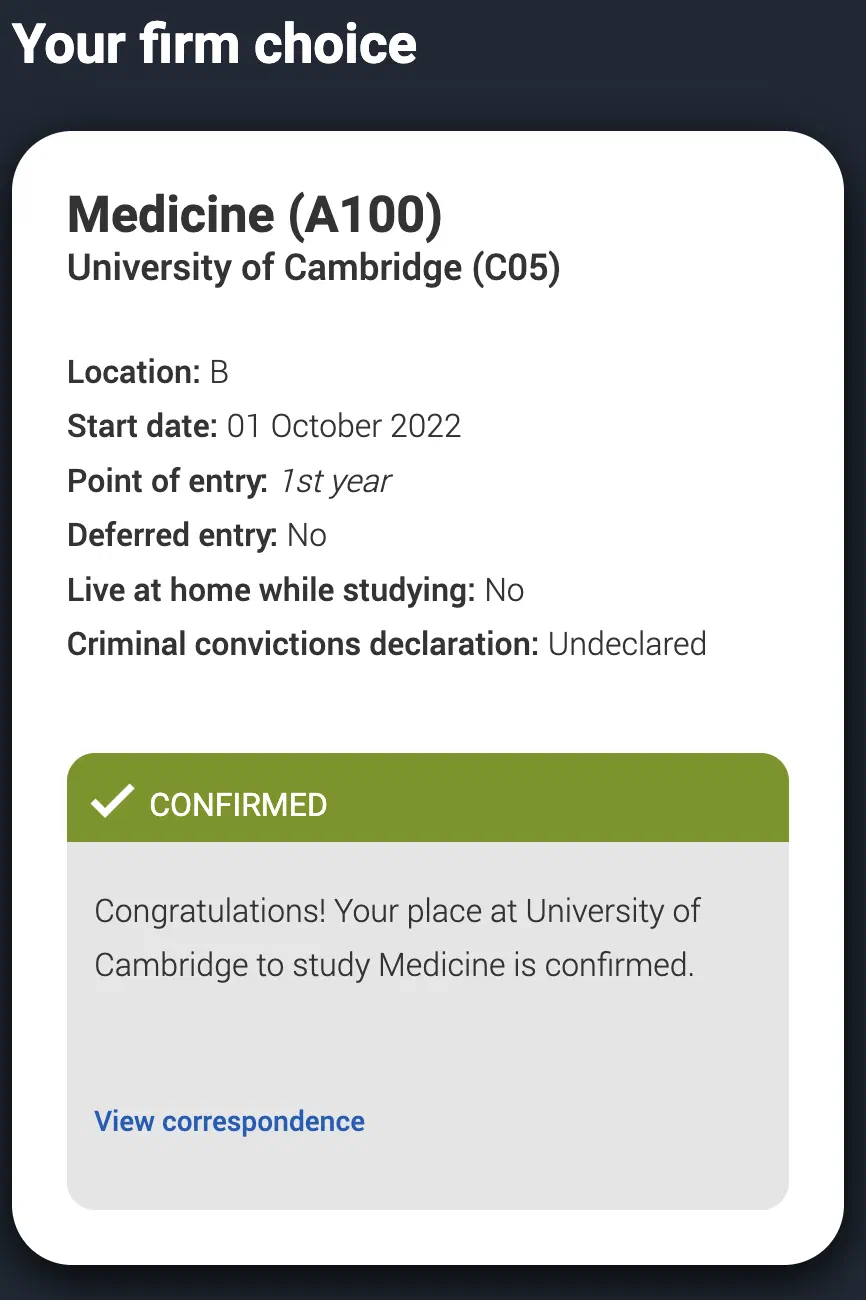
If you receive an offer, congratulations.
You have now completed what I think is the more complicated part of the process.
For Cambridge Medicine, the standard conditional A-level offer is typically A*A*A. That is another reason I like the idea of getting ahead so much.
By this point, ideally, there should be very little completely new material left for you to learn. Your job can increasingly become exam practice: past papers, identifying weaknesses, correcting them, learning how mark schemes reward answers and repeating that cycle until the actual exams feel extremely familiar.
You are no longer simultaneously trying to learn huge parts of the course and master exam technique.
You have separated the two problems.
That makes the final few months much easier to manage.
You do not need to be the smartest person in your school
I think a lot of people rule themselves out of Cambridge far too early because they know someone who seems frighteningly clever.
There is always that person.
They barely appear to revise, casually get almost everything right and somehow make you reconsider whether you have ever understood Biology at all.
I do not think you need to be that person.
You obviously need to be academically strong. Cambridge Medicine is competitive. Pretending otherwise would be useless.
But raw cleverness is only part of what determines how strong your application becomes.
Imagine one student starts Year 12 with slightly more natural ability but works inconsistently. Another is already capable, but spends the next 18 months getting ahead academically, preparing properly for assessments, reading beyond the syllabus, improving their UCAT performance and practising how to reason through unfamiliar scientific problems.
By December of Year 13, you are no longer comparing the same two people you were comparing at the beginning of Year 12.
One of them has compounded.
That is the part you can control.
Hard work cannot guarantee a Cambridge offer. There are too many strong applicants and too many variables for anyone to honestly promise that. But you can make yourself a substantially harder applicant to reject.
That should be the goal.
Think backwards from the interview
If I were starting again, I would literally work backwards.
The interview is in December. What level of biological knowledge do I want by then? What do I therefore need to have finished by October? What predicted grades do I need to be on track for? What needs to happen in my Year 12 mocks to make those predictions unsurprising? When does UCAT preparation need to start? What supercurricular work will actually deepen my understanding rather than merely occupy my time?
Then I would build the year around those answers.
That is the blueprint.
Not doing everything. Doing the right things early enough that each stage makes the next one easier.
Drop the things that do not matter. Get ahead of your course. Make your predicted grades as strong as possible. Explore Medicine and science beyond what your teachers require. Prepare seriously for the UCAT. Build an application that contains evidence rather than adjectives. Start thinking like an interview candidate before the interview invitation arrives. And accumulate enough knowledge that, when Cambridge gives you something unfamiliar, you have plenty of ideas available to attack it.
You do not control whether Cambridge ultimately gives you an offer.
You do control whether, between now and December of Year 13, that progress bar keeps moving.
Any questions at all, please feel free to get in touch!